

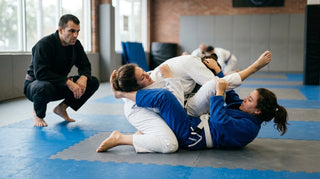
Search "kroyler gracie jiu-jitsu" and you'll hit a wall of half-answers, forum guesses, and outdated bios that don't explain who Kroyler actually is or why his name carries weight. That's a problem if you're trying to understand the Gracie family tree, the roots of BJJ, or why this lineage still shapes the sport today. You deserve the real story. This breaks down Kroyler Gracie's place in jiu-jitsu history, what his legacy means for practitioners in 2026, and why the Gracie name remains the standard the entire sport is measured against.
Understanding Kroyler Gracie Jiu-Jitsu and Where the Name Comes From
How the Gracie Name Became Synonymous With BJJ Culture
Let's clear something up first. "Kroyler" isn't a separate style. It's not a lost branch of the family tree either. It's a phonetic variant — basically a misspelling — that's popped up over the years across affiliate gyms, forum posts, and word-of-mouth searches tied to Royce Gracie's name and his academy network. You'll see it typed different ways by people who heard the name before they ever read it. If you're hearing "Kroyler," what's actually being referenced is Royce Gracie jiu-jitsu, full stop.
That naming confusion actually says something bigger: the Gracie name traveled faster than the spelling could keep up with. It got attached to gyms, kids' programs, seminar series, and eventually branded apparel worn far outside the academy walls. That's a rare kind of reach. Most martial arts brands stay confined to the mat; this one became streetwear, gym culture, and identity all at once, and understanding how affiliate schools built on that name actually run day to day shows just how far the branding stretched.
None of that happens without the UFC groundwork Royce laid in the 90s. His run through the early tournaments didn't just win fights — it introduced an entire country to ground fighting. That's the foundation the modern global BJJ boom still sits on, and it's worth learning about the fighter who brought jiu-jitsu to the world stage in the first place.
The Gracie Family Lineage That Built Modern BJJ
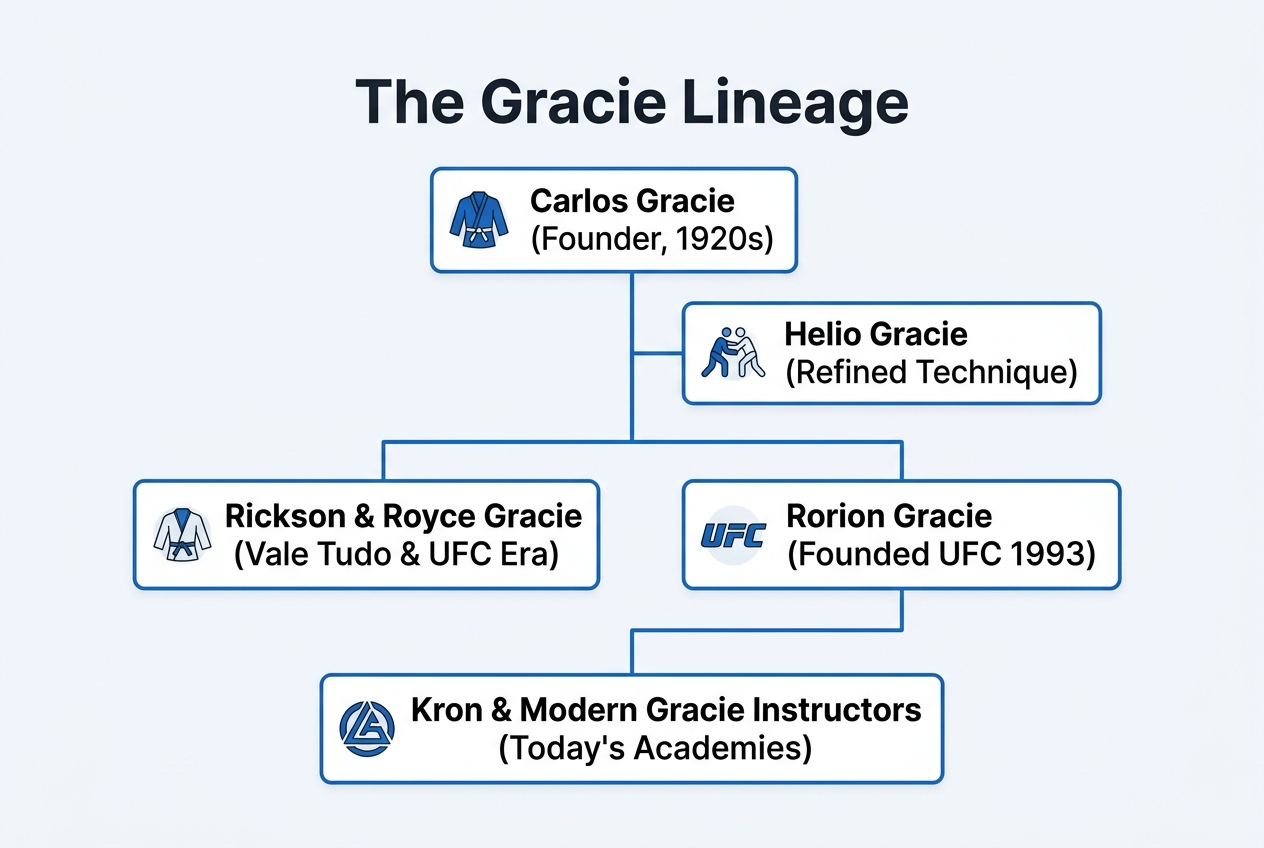
Helio to Royce: A Direct Line of Technique and Philosophy
Helio Gracie didn't invent grappling. What he did was reshape it around leverage, timing, and patience so a smaller man could beat a bigger one. That idea became the backbone of the family's self-defense philosophy, and it passed down almost untouched to his son Royce. When Royce stepped into the octagon at UFC 1 in 1993, he wasn't showcasing a sport. He was demonstrating a survival system built over six decades, tested in Gracie Academy challenge matches long before pay-per-view made it famous.
That fight changed how the world saw fighting itself. Suddenly, size and strength weren't the deciding factors anymore. Technique was. Royce's run through three tournaments cemented Helio's teachings as the foundation of modern mixed martial arts, and it's the reason so many academies still teach closed guard escapes and positional control before anything flashy. The lineage isn't nostalgia. It's the actual curriculum many gyms still run today.
Lineage matters more than most beginners realize when picking a school. An instructor who can trace their training back through a direct line, rather than a patchwork of seminars, usually teaches with more structural consistency. It's why researching an academy's affiliate history is worth the twenty minutes it takes, and it's also why family branches like the one behind Kroyler Gracie BJJ still draw students who want that documented connection back to Helio's original teaching.
Family history isn't just trivia here, either. Pieces like the gracie spotlight rorion gracie profile exist precisely because understanding the people behind the technique changes how you train it. Skip the backstory and jiu-jitsu is just moves. Learn it, and every armbar carries a reason.

What Sets an Authentic Gracie-Rooted Program Apart
Not every school with "Gracie" on the wall actually teaches like one. The name matters less than the culture behind it. What you're really looking for is a program that treats jiu-jitsu as a lifelong practice, not a highlight reel.
Signs of a Program That Honors the Gracie Tradition
True Gracie-lineage schools feel less like a gym and more like an extended family. Instructors know your name, your goals, and probably your kid's name too. That's not a marketing line — it's how the tradition was built from day one in Rio.
- Instructors correct technique with patience instead of humiliation, treating mistakes as part of learning rather than something to punish on the mat.
- Higher belts roll with lower belts at a pace that teaches, not one that's designed to prove a point or protect an ego.
- Kids' classes run separately from adult classes, with age-appropriate drills and clear behavior expectations enforced consistently.
- The school hosts open mats, seminars, or family events that build a genuine sense of community outside scheduled class time.
- Curriculum progresses logically from self-defense basics to live rolling, so beginners aren't thrown into hard sparring before they're ready.
You can learn a lot about a school's roots before you ever step on the mat. Reading up on a place like the royce gracie academy gives a useful benchmark for what that lineage is supposed to look like in practice.
What to Avoid in Ego-Driven Gyms
Some gyms confuse toughness with teaching. Watch for classes where new students get smashed just to satisfy someone's ego, where instructors play favorites, or where kids and adults train side by side with no real structure. If the vibe feels more like a proving ground than a school, trust that instinct. It's usually right.
BJJ Belt Progression Explained
Progress in Jiu-Jitsu is slow by design. The belt system runs white, blue, purple, brown, then black, and each color represents years of mat time, not weeks. Some schools award stripes along the way, four per belt usually, marking small technical milestones before a full promotion. Anyone researching the sport through a site like Kroyler Gracie Jiu-Jitsu will notice how heavily the lineage and ranking structure get emphasized, since rank carries real weight in this tradition.
Here's roughly what to expect, based on averages reported across established academies:
| Belt | Typical Time to Earn | Focus at This Stage |
|---|---|---|
| White | 1–2 years | Survival, basic escapes, terminology |
| Blue | 2 years | Building a game, live rolling volume |
| Purple | 2–3 years | Chaining techniques, teaching basics |
| Brown | 1–2 years | Refinement, sharper timing |
| Black | Lifetime | Mastery, continued study |
Stripes matter more than people think. They're not just participation trophies. A coach adds one when a specific gap closes — maybe your guard retention, maybe your takedown defense. That's mental growth as much as physical. Rank reflects the whole picture, not just how many people you can tap.
Knowing this timeline early saves you frustration. Getting your blue belt in eight months doesn't happen at a serious school, and if it does, be suspicious. Patience isn't optional here. It's the whole point.
Comparing Training Paths: Self-Defense Focus vs. Sport Competition Focus
Every practitioner eventually faces this fork in the road. Royce Gracie's original approach was built for the street: no weight classes, no points, just survival against a bigger, meaner opponent. Sport BJJ took that base and built a whole world of rules, advantages, and tournament strategy around it. Neither is wrong. But they train different muscles, literally and mentally, and picking one without knowing the trade-offs can waste months of your time.
Choosing the Right Focus for Your Goals
Following the active Kroyler Gracie BJJ community can give you a feel for how self-defense-rooted schools actually train day to day, before you commit to a gym. The table below breaks down how each path stacks up against common goals.
| Goal | Self-Defense Focus | Sport Competition Focus |
|---|---|---|
| General fitness | Moderate intensity, functional strength | High cardio demand, explosive conditioning |
| Real-world protection | Strong emphasis on strikes, clothing grabs, multiple attackers | Limited; rules exclude strikes and weapons scenarios |
| Competition readiness | Minimal, not the priority | Built specifically for points, advantages, and referees |
| Youth development | Confidence, discipline, anti-bullying skills | Goal-setting, sportsmanship, structured rankings |
| Time to first real skill | A few months for basic escapes | Often a year-plus before medaling matters |
Here's the blunt version: if you want to feel safer walking to your car at night, sport rules alone won't cut it. If you dream of medals, pure self-defense drilling will bore you fast. Most solid academies blend both, but knowing which one drives your training will keep you motivated instead of frustrated.
Tips and Tricks for Beginners Starting Jiu-Jitsu
Beginner Mistakes to Avoid Early On
Every white belt makes the same mistakes. That's fine — it's part of the process. But knowing them ahead of time will save you months of frustration and a fair number of bruised egos on the mat.
- Skipping classes when you feel lost — consistency matters more than talent early on, and showing up even when you're confused is how the pieces eventually click.
- Chasing submissions before learning defense — focus on positional control, framing, and escapes first, because a beginner who can survive bad positions will outlast one who only knows a couple of flashy attacks.
- Training in the wrong clothing — cotton shirts that bunch up or restrict movement make drilling miserable, so invest in gi-free training apparel built for grappling; it should stretch, breathe, and stay put during a scramble.
- Staying quiet instead of asking questions — instructors expect beginners to ask about grips, timing, and weight distribution, and watching how higher belts move during live rolling teaches you more than any video ever will.
- Ignoring recovery between sessions — stretch your neck, hips, and shoulders after class, drink water throughout the day rather than just before training, and give your body at least one full rest day a week.
- Comparing yourself to people with years of mat time — it's a pointless exercise and it'll only slow you down.
Outside the academy, plenty of beginners follow grappling pages to stay motivated and pick up small technical details between classes; accounts like Kroyler Gracie Jiu-Jitsu (@kroylergraciejj) offer a steady stream of drilling clips worth studying frame by frame. Pair that with patience, and progress tends to take care of itself.
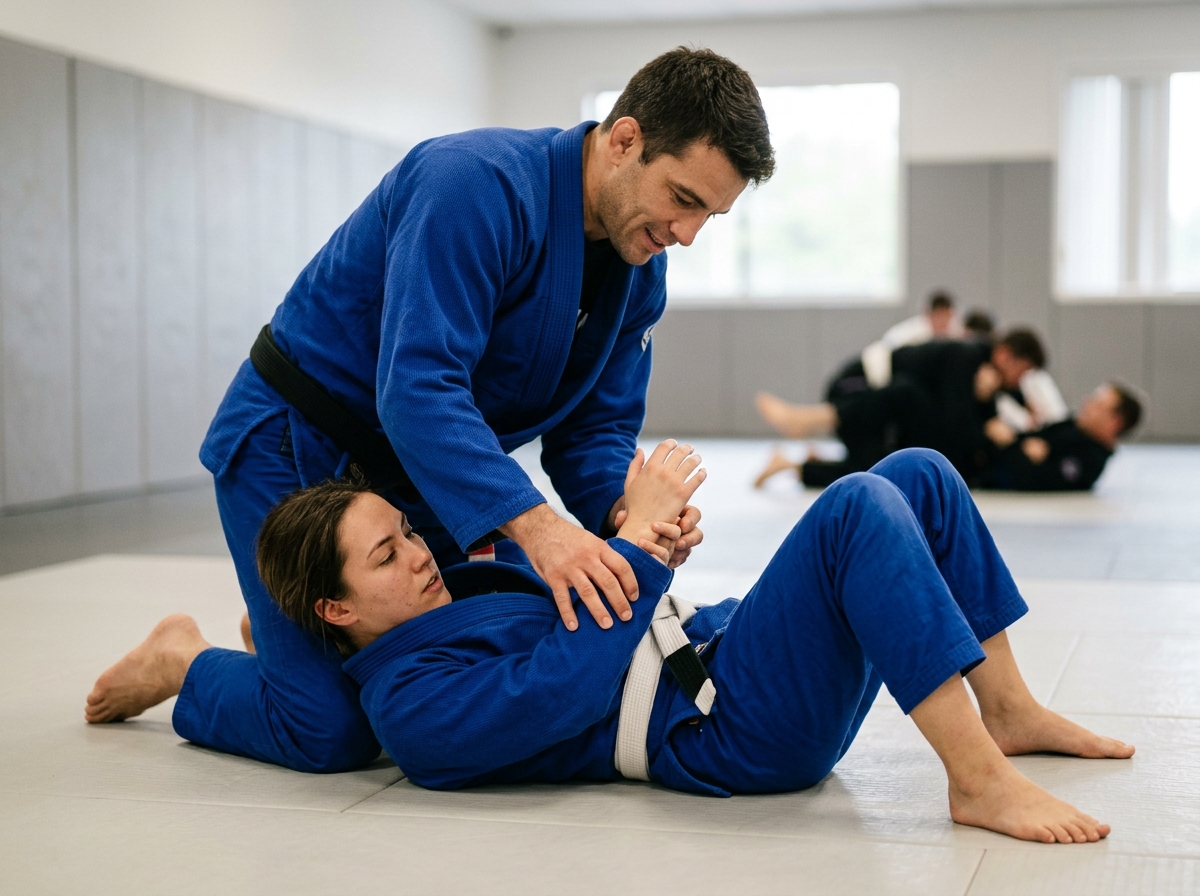
Representing the Kroyler Gracie Jiu-Jitsu Legacy Off the Mat
Everyday Apparel as a Symbol of Training Identity
Walk into any gym parking lot and you'll spot it fast: the faded academy shirt, the hoodie with a family crest on the chest. That's not an accident. For a lot of practitioners, what you wear off the mat says as much about your journey as your belt does. A shirt tied to Gracie history isn't just clothing — it's a small daily statement that you're part of something with roots, not just a passing hobby. Wearing that history is a quiet form of respect.
Branded tees, hoodies, and accessories do more than look good in a gym bag. They build community identity. When training partners recognize the same lineage on each other's shirts at a seminar or a local tournament, it starts conversations and signals shared values before a single word gets exchanged. Curiosity about that connection runs deep enough that people go looking for firsthand accounts; an old but well-read interview with Kroyler Gracie still gets passed around by practitioners trying to understand this branch of the family story.
Here's the blunt part: generic martial-arts merch with a random dragon or a stock kanji print doesn't carry any of that weight. It's fine as clothing. It's meaningless as identity. Apparel tied directly to actual lineage, and reinforced by names respected across combat sports — think commentators, UFC veterans, longtime black belts — gives the wearer something a mall rack never can: a real story behind the fabric.
Bringing the Gracie Legacy Into Your Everyday Life
Where to Go From Here
By now it should be clear that lineage, culture, and community are what separate a genuine Gracie-rooted program from a gym that just borrows the name. The techniques matter, sure. But it's the people, the shared history, and the way training gets passed down instructor to student that gives the whole thing weight. If you're searching for that experience firsthand, checking a listing such as Kroyler Gracie Jiu-Jitsu in Elkhart, IN United States is a reasonable place to start scoping out what a local school actually offers before you commit to a mat fee.
From there, don't limit yourself to just showing up for class. The tradition lives on and off the mat — in gear bags, gi patches, hoodies worn to morning coffee, t-shirts that spark a conversation with a stranger who trained twenty years ago. Both expressions matter. One without the other feels incomplete, honestly.
Good news: representing the legacy doesn't require much effort these days. Adult and youth apparel collections, accessories, and worldwide shipping mean fans and practitioners alike can wear the history rather than just study it. Pick a piece that fits your life, wear it well, and let the rest take care of itself.
If the Kroyler Gracie story has you wanting to wear your appreciation for this jiu-jitsu lineage, Royce Gracie Lifestyle offers apparel that connects directly back to the source, from the Helio Gracie Lineage Tee to the Royce Gracie Rank Hoodie. Every order ships with free standard shipping and returns, so there's no risk in building out your collection. Head over to browse the Gracie Apparel lines for adults and kids, and bring a piece of this legacy into your everyday wardrobe.