

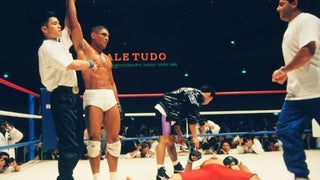
Few names in martial arts history carry as much mystique as Rickson Gracie. The man often called the greatest fighter the Gracie family ever produced claims a record that has sparked debate for decades: over 400 fights without a single loss. But what's the truth behind these numbers? In this comprehensive breakdown, we separate fact from legend and examine every verifiable aspect of Rickson's fighting career.
The Quick Facts: Rickson Gracie Stats
|
Category |
Details |
|
Born |
November 21, 1959, Rio de Janeiro, Brazil |
|
Height |
5'10" (178 cm) |
|
Weight Class |
Middleweight (~185 lbs) |
|
Verified MMA Record |
11-0 (all by submission) |
|
BJJ Rank |
9th Degree Red Belt |
|
Notable Achievements |
Vale Tudo Japan Champion (1994, 1995), Pride FC headliner |
The 400-0 Claim: Where Does This Number Come From?
Rickson Gracie has consistently maintained he's never lost a fight in his life. The number has evolved over the years—sometimes cited as 400, other times as 465, and in recent interviews, Rickson has even suggested 450 or higher could be accurate.
According to Rickson himself, this figure includes:
-
Professional MMA/Vale Tudo fights (11 documented)
-
Brazilian Jiu-Jitsu tournament matches
-
Sambo competitions
-
Judo tournaments
-
Challenge matches at gyms
-
Street fights and beach confrontations
-
Seminar sparring sessions
In a 2022 podcast appearance, Rickson explained his counting methodology: every seminar where he submitted all participants, every tournament he entered across multiple martial arts, every challenge match—they all count toward his undefeated streak.
What His Own Father Said
Perhaps the most compelling criticism of the 400-0 record came from Rickson's own father, Hélio Gracie—the co-founder of Brazilian Jiu-Jitsu.
Hélio publicly disputed his son's claim, stating that Rickson was counting practice sessions and amateur bouts to reach such a high number. According to Hélio, if he counted fights the same way Rickson did, his own record would exceed one million.
Rickson's brother Relson Gracie offered a more nuanced take in a 2020 interview. While not disputing that Rickson had the fights, Relson clarified that the number includes gym challenges, training sessions, and competitions that weren't "fights" in the traditional sense. The actual documented Vale Tudo and MMA fights, according to Relson, numbered around 14-15 in Japan plus a couple more in Brazil.
The Verified Professional Record: 11-0
When examining only documented professional MMA and Vale Tudo fights, Rickson's record stands at 11 wins with zero losses—all by submission. Here's the complete breakdown:
Early Brazil Era (1980-1988)
Fight 1: vs. Rei Zulu I (1980) — Brasília, Brazil
-
Result: Win by rear-naked choke (Round 3)
-
Significance: This was the fight that made Rickson famous. Rei Zulu was a feared Brazilian brawler weighing 230 pounds with an alleged record of 140-0. The 20-year-old Rickson, giving up significant weight, submitted the giant in front of his home crowd.
Fight 2: vs. Rei Zulu II (1984) — Maracanãzinho Stadium, Rio de Janeiro
-
Result: Win by choke (Round 2)
-
Significance: The rematch drew 20,000 spectators. This time Rickson finished even faster, cementing his status as Brazil's top fighter.
Vale Tudo Japan 1994
Fight 3: vs. Yoshinori Nishi
-
Result: Win by rear-naked choke (2:52, Round 1)
-
Style: Daido-juku karate
Fight 4: vs. David Levicki
-
Result: Win by TKO/submission to punches (2:40, Round 1)
-
Style: Wing Chun
Fight 5: vs. Bud Smith
-
Result: Win by submission to punches (0:39, Round 1)
-
Style: Kickboxing
-
Significance: Won the tournament, defeating three opponents in one night.
Vale Tudo Japan 1995
Fight 6: vs. Yoshihisa Yamamoto
-
Result: Win by submission (Round 1)
-
Style: Shoot wrestling (Fighting Network Rings)
Fight 7: vs. Koichiro Kimura
-
Result: Win by submission (Round 1)
-
Style: Pro wrestling
Fight 8: vs. Yuki Nakai
-
Result: Win by rear-naked choke (Round 1)
-
Style: Shooto
-
Significance: Nakai, fighting nearly blind from an earlier bout against Gerard Gordeau, showed incredible heart but eventually succumbed. This finals victory gave Rickson back-to-back tournament wins.
Pride Fighting Championships Era
Fight 9: vs. Nobuhiko Takada — Pride 1 (October 11, 1997)
-
Result: Win by armbar (4:47, Round 1)
-
Venue: Tokyo Dome (47,860 spectators)
-
Significance: The main event of Pride's inaugural show. Rickson submitted Japan's most famous pro wrestler, helping launch what would become the world's premier MMA organization.
Fight 10: vs. Nobuhiko Takada II — Pride 4 (October 11, 1998)
-
Result: Win by armbar (Round 1)
-
Venue: Tokyo Dome (50,000 spectators)
-
Significance: The highly anticipated rematch drew even more fans. Takada showed improvement but ultimately met the same fate.
Fight 11: vs. Masakatsu Funaki — Colosseum 2000 (May 26, 2000)
-
Result: Win by rear-naked choke (11:46, Round 1)
-
Venue: Tokyo Dome
-
TV Audience: 30 million viewers
-
Significance: Rickson's final professional fight. Funaki was a Pancrase legend and legitimate threat, making this Rickson's most credible opponent. This would be the last time Rickson ever fought professionally.
The Fights That Weren't Official (But Absolutely Happened)
The Hugo Duarte Beach Fight (1988)
One of the most famous unsanctioned fights in martial arts history took place on Pepe Beach in Rio de Janeiro. The rivalry between Brazilian Jiu-Jitsu and Luta Livre—a no-gi grappling style—was at its peak. Hugo Duarte, a rising Luta Livre star under Marco Ruas, had been publicly insulting the Gracie name.
Rickson, accompanied by approximately 50 supporters including a young Ryan Gracie with a camera, confronted Duarte on the beach. After slapping Duarte across the face, the fight began. Despite some controversy about sand being thrown and possible interference, Rickson mounted Duarte and forced a submission through strikes.
One week later, Duarte returned to the Gracie Academy with 60-70 armed Luta Livre practitioners seeking revenge. Remarkably, it was 76-year-old Hélio Gracie who confronted the mob and negotiated terms for a rematch. The second fight took place in the academy parking lot, with Rickson again emerging victorious—this time more decisively. A gunshot fired during the confrontation brought police to the scene, and the BJJ vs. Luta Livre rivalry would continue without Rickson, who left for the United States shortly after.
The Yoji Anjo Incident (1994)
After Rickson's dominant performance at Vale Tudo Japan 1994, Japanese pro wrestler Nobuhiko Takada felt his country's martial arts honor had been disgraced. His student, Yoji Anjo, traveled to California with media in tow to challenge Rickson at his academy.
Rickson agreed to fight—but not at a Japanese event. The fight would happen right there, behind closed doors, with no audience or press present. Anjo reluctantly accepted.
What followed was described as a systematic beatdown. Rickson took Anjo down, achieved mount position, and proceeded to punish him with strikes until the fight was stopped. The Gracie family recorded the encounter, and photos of Anjo's battered face were later released to counter his claims of being attacked by multiple Gracie students.
The One Loss Nobody Talks About
For all the talk of an undefeated record, there is one documented loss: at the 1993 U.S. Sambo Championships in Oklahoma, Rickson was defeated by Dr. Ron Tripp, a decorated judo and sambo competitor.
According to Tripp, the match was quick. He executed an uchi mata throw on Rickson, and under FIAS International Sambo rules, the throw was scored as a full point, ending the match in 47 seconds.
Rickson disputes this loss, claiming he was unaware of the specific rules—despite having claimed to be a two-time Pan American Sambo champion at the time. The BJJ Heroes website also notes this as a recorded loss in sport sambo.
Whether you count this as a "real" loss depends on your definition. It wasn't a vale tudo fight or MMA match, but it was an official competition with rules and a referee.
The Fight That Never Happened: Rickson vs. Sakuraba
The fight every martial arts fan wanted to see was Rickson Gracie vs. Kazushi Sakuraba, the "Gracie Hunter" who systematically defeated Royler, Royce, Renzo, and Ryan Gracie in Pride.
After Sakuraba defeated Royler at Pride 8 in 2000, he grabbed the microphone and challenged Rickson, who was in his brother's corner. Negotiations began, with Japanese television reportedly offering Rickson $5 million—what would have been the biggest purse in MMA history at the time.
But fate intervened. In December 2000, Rickson's eldest son Rockson was found dead in a New York hotel room from a drug overdose. The 19-year-old had been a three-time Pan American BJJ champion and was considered the brightest prospect in the Gracie family.
Devastated, Rickson withdrew from negotiations. By the time he had processed his grief, Sakuraba had lost to Wanderlei Silva, and the fight had lost its momentum. The offer dropped to a third of the original amount, and the matchup never materialized.
When asked about the worst beating he ever took, Rickson's answer wasn't any fight—it was losing Rockson. The tragedy ended his competitive career at 42, while he was still in his athletic prime.
Rickson's Most Famous Opponents: Where Are They Now?
|
Fighter |
Result vs. Rickson |
Later Career |
|
Rei Zulu |
Lost twice |
Continued fighting; his son Zuluzinho competed in Pride |
|
Hugo Duarte |
Lost twice |
Competed in UFC and Pride with limited success |
|
Nobuhiko Takada |
Lost twice |
Became a Pride promoter and pro wrestling legend |
|
Masakatsu Funaki |
Lost |
Pancrase founder, competed until 2015 |
|
Yuki Nakai |
Lost |
Founded Shooto organization, pioneer of Japanese MMA |
The Documentary That Made Him a Legend: "Choke"
Released in 1999, the documentary "Choke" followed Rickson as he prepared for Vale Tudo Japan 1995. Directed by Robert Goodman and distributed by Manga Entertainment to 23 countries, the film offered an intimate look at Rickson's training, philosophy, and family life—including touching scenes with a young Rockson.
The documentary is credited with introducing Rickson to international audiences beyond the martial arts community and remains essential viewing for understanding his mystique.
What BJJ Legends Say About Rickson
The respect Rickson commands from his peers is nearly universal:
Olympic wrestling gold medalist Mark Schultz, after rolling with Rickson in 1992, said Rickson was "the best fighter I'd ever seen" and called him the toughest opponent he'd faced.
Multiple BJJ world champions including Ricardo Arona, Demian Maia, and Paulo Filho have called Rickson the greatest BJJ practitioner of all time.
Even those who question the 400-0 number rarely question his skill. The debate isn't whether Rickson was great—it's whether the exact number matters.
The Verdict: Separating Myth from Reality
So what's the truth about Rickson Gracie's record?
The verified facts:
-
11-0 in professional MMA/Vale Tudo, all by submission
-
Undefeated in documented BJJ competition at black belt level
-
One recorded loss in sport sambo (disputed)
-
Never defeated in any documented no-holds-barred fight
The gray area:
-
Challenge matches at gyms (happened, but not verified numbers)
-
Beach fights and street confrontations (some documented, others not)
-
Seminar sparring sessions (questionable whether these count as "fights")
The conclusion:
Was Rickson Gracie one of the greatest fighters of his era? Absolutely. Did he likely win hundreds of encounters across training, competitions, and challenges? Almost certainly. Does the exact number of 400 (or 450, or 465) represent verifiable "fights" in the way most people understand the term? Probably not.
But perhaps the number matters less than the reality: in the documented fights we can verify, against the opponents we can name, Rickson Gracie was never defeated in actual combat. And in an era before the UFC existed, when the Gracies were proving their art against all comers, Rickson was the one they called when the family's honor was on the line.
The myth and the man may never be fully separated—and maybe that's exactly how Rickson prefers it.
Further Reading and Resources
-
"Breathe: A Life in Flow" — Rickson Gracie's autobiography
-
"Choke" (1999) — Documentary available on various streaming platforms
-
Rickson Gracie Academy — Official training resources at ricksongracie.com
-
Jiu-Jitsu Global Federation — Rickson's organization promoting traditional BJJ
More from the Gracie Series