

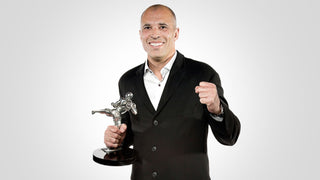
The most famous Gracie to mainstream audiences, Royce proved to the world that technique beats size.
Quick Facts
|
Detail |
Information |
|
Born |
December 12, 1966, Rio de Janeiro, Brazil |
|
Relation |
Son of Hélio Gracie |
|
Weight |
~178 lbs (80 kg) |
|
BJJ Rank |
7th Degree Red & Black Coral Belt |
|
MMA Record |
15-2-3 |
|
Notable |
3x UFC Tournament Champion, UFC Hall of Fame (2003) |
The Legacy
When people who don't follow martial arts hear the name "Gracie," they think of Royce. He is, without question, the most famous member of the family globally—and for good reason.
On November 12, 1993, the slim Brazilian stepped into an octagonal cage in Denver, Colorado, wearing a white gi and changed combat sports forever. By the end of the night, he had submitted three larger opponents to win the first UFC tournament, proving to millions of viewers that Brazilian Jiu-Jitsu could defeat any martial art.
Why Royce?
The Gracie family made a deliberate choice when selecting who would represent BJJ at UFC 1. Rickson Gracie was the family's best fighter—intimidating, undefeated, and proven in Vale Tudo. But they chose Royce specifically because he didn't look like a fighter.
At 178 pounds with a lean frame, Royce would be the smallest competitor in the tournament. If he won—against boxers, wrestlers, and karate champions who outweighed him by 30-50 pounds—the message would be undeniable: size doesn't matter when you have superior technique.
As his brother Rorion later explained, he wanted the world to see that even an "average-looking" person could defeat bigger, stronger opponents with proper technique.
UFC 1: The Night Everything Changed
The first Ultimate Fighting Championship featured an eight-man single-elimination tournament with almost no rules. No weight classes. No time limits. No gloves required.
Royce's Tournament Run:
|
Round |
Opponent |
Style |
Weight |
Result |
|
Quarterfinal |
Art Jimmerson |
Boxing |
196 lbs |
Submission, 2:18 |
|
Semifinal |
Ken Shamrock |
Shootfighting |
220 lbs |
Submission (gi choke), 0:57 |
|
Final |
Gerard Gordeau |
Savate/Karate |
216 lbs |
Submission (RNC), 1:44 |
Total fight time: 4 minutes, 59 seconds.
Three fights. Three submissions. Three opponents who outweighed him significantly. The message was clear.
Career Highlights
UFC Dominance (1993-1995)
Royce didn't stop at UFC 1. He returned to dominate:
-
UFC 2 (1994): Won four fights in one night, including victories over Jason DeLucia, Remco Pardoel, and Patrick Smith
-
UFC 4 (1994): Won three more fights to capture his third tournament championship
-
UFC 5 (1995): Fought Ken Shamrock to a 36-minute draw in the first UFC Superfight—still the longest fight in UFC history
After UFC 5, Royce and Rorion left the organization due to disputes over proposed rule changes including time limits and weight classes.
The Sakuraba Epic (2000)
At PRIDE Grand Prix 2000, Royce faced Japanese catch wrestler Kazushi Sakuraba in what became one of the most legendary fights ever.
The rules were unique: 15-minute rounds with no limit on total time. The fight went 90 minutes across six rounds. Sakuraba systematically attacked Royce's legs while Royce hunted submissions. Eventually, Royce's corner threw in the towel when his leg was too damaged to continue.
It was Royce's first official loss—but cemented both men as legends.
Later Career
-
vs. Akebono (2004): Submitted the 490-pound sumo grand champion via armlock
-
vs. Matt Hughes (2006): Returned to the UFC at age 39, lost via TKO
-
vs. Ken Shamrock (2016): Final career fight at Bellator 149, won via TKO in round 1
The Full Fight Record
|
Year |
Opponent |
Event |
Result |
Method |
|
1993 |
Art Jimmerson |
UFC 1 |
Win |
Submission (mount) |
|
1993 |
Ken Shamrock |
UFC 1 |
Win |
Submission (gi choke) |
|
1993 |
Gerard Gordeau |
UFC 1 |
Win |
Submission (RNC) |
|
1994 |
Minoki Ichihara |
UFC 2 |
Win |
Submission (armlock) |
|
1994 |
Jason DeLucia |
UFC 2 |
Win |
Submission (armlock) |
|
1994 |
Remco Pardoel |
UFC 2 |
Win |
Submission (lapel choke) |
|
1994 |
Patrick Smith |
UFC 2 |
Win |
Submission (gi choke) |
|
1994 |
Ron Van Clief |
UFC 4 |
Win |
Submission (RNC) |
|
1994 |
Keith Hackney |
UFC 4 |
Win |
Submission (RNC) |
|
1994 |
Dan Severn |
UFC 4 |
Win |
Submission (triangle) |
|
1995 |
Ken Shamrock |
UFC 5 |
Draw |
Time limit (36:00) |
|
1995 |
Harold Howard |
UFC 5 |
NC |
Opponent withdrew |
|
1998 |
Nobuhiko Takada |
Pride 2 |
Win |
Submission (armbar) |
|
2000 |
Kazushi Sakuraba |
Pride GP 2000 |
Loss |
Corner stoppage |
|
2004 |
Akebono |
K-1 Dynamite!! |
Win |
Submission (armlock) |
|
2006 |
Matt Hughes |
UFC 60 |
Loss |
TKO (punches) |
|
2007 |
Kazushi Sakuraba |
Dynamite!! 2007 |
Draw |
Majority draw |
|
2016 |
Ken Shamrock |
Bellator 149 |
Win |
TKO (punches) |
Beyond the Octagon
Royce wasn't just a fighter—he was BJJ's greatest ambassador. His victories sparked a worldwide revolution in martial arts training. Before UFC 1, most American martial artists focused primarily on striking. After watching Royce submit larger opponents with ease, the entire approach to combat sports changed.
Today, every serious MMA fighter trains grappling specifically because of what Royce proved in those early events.
Hall of Fame
At UFC 45 in November 2003—the ten-year anniversary of UFC 1—Royce Gracie and Ken Shamrock became the first inductees into the UFC Hall of Fame.
As UFC President Dana White said: "We feel that no two individuals are more deserving than Royce and Ken to be the charter members."
In 2016, Royce was also inducted into the International Sports Hall of Fame.
The Rivalry with Shamrock
Royce and Ken Shamrock defined the early UFC. Their first meeting at UFC 1 was the most anticipated matchup because Shamrock actually had grappling experience—he was the "World's Most Dangerous Man," a shootfighter who had competed in Pancrase.
Royce submitted him in 57 seconds.
Their rematch at UFC 5 went 36 minutes to a draw. Their third meeting at Bellator 149 in 2016—over two decades later—ended with Royce winning via TKO.
The rivalry spans the entire history of MMA.
Legacy
Royce Gracie proved something that changed the world: a smaller, technical fighter can defeat larger, stronger opponents. That simple truth launched an entire industry.
Without Royce's performances at the early UFCs:
-
Brazilian Jiu-Jitsu wouldn't be a global phenomenon
-
MMA fighters wouldn't emphasize ground fighting
-
The UFC itself might not have survived its early years
Every grappler who steps on the mat, every MMA fighter who drills takedowns, every kid who learns BJJ for self-defense—they all owe something to the slim Brazilian who wore a white gi into the octagon in 1993.
More from the Gracie Series