


You want to learn real self-defense, but the sheer volume of jiu-jitsu techniques out there feels overwhelming. Where do you even start? Gracie Combatives cuts through that noise. It's the exact 36-technique curriculum the Gracie family designed to make anyone street-ready, fast. This guide breaks down what it is, why it works, and how it connects to the deeper legacy of the art Royce Gracie helped bring to the world.
What Is Gracie Combatives
Origins in Helio Gracie's Teachings
Every technique in this curriculum traces back to one man's body of work. Helio Gracie built his version of jiu-jitsu around leverage and timing, not size or strength. He was smaller and frailer than most opponents he faced. His sons Rener and Ryron took that lifetime of teaching and organized it into a structured program anyone could follow, whether they'd ever set foot on a mat or not.
The result is a curriculum built for people, not point systems. If you want the family history behind this, the gracie spotlight rorion gracie feature traces how the teachings moved from Brazil to the United States and eventually into the structured lesson plan used today. Rener and Ryron didn't invent new moves. They distilled decades of family knowledge into something teachable.
That distinction matters. A lot of martial arts get watered down as they scale. This one didn't. It got more organized, not less rigorous, and that's rare.
How It Differs From Sport Jiu-Jitsu
Sport jiu-jitsu rewards points, advantages, and guard-passing sequences built for the scoreboard. This curriculum ignores all of that. It's built around 36 lessons that establish positional control, reliable escapes, and a handful of submissions that work against someone who's actually trying to hurt you, not someone playing for a ref's decision. There's no penalty for stalling, because there's no match clock in a real confrontation.
That's a meaningful split in priorities. Sport athletes train to score against a resisting opponent inside rules and weight classes. Someone learning self-defense fundamentals needs answers for grabs, punches, and pins that ignore all of that. A great short primer on this gap is the There's a lot of jiu-jitsu out there, but understanding a breakdown, which walks through why technique selection changes once competition rules disappear.
Think of it this way: one path trains you for a tournament bracket, the other trains you for a bad night outside a bar. Both are jiu-jitsu. They are not the same skill set.
Breaking Down the 36-Lesson Curriculum
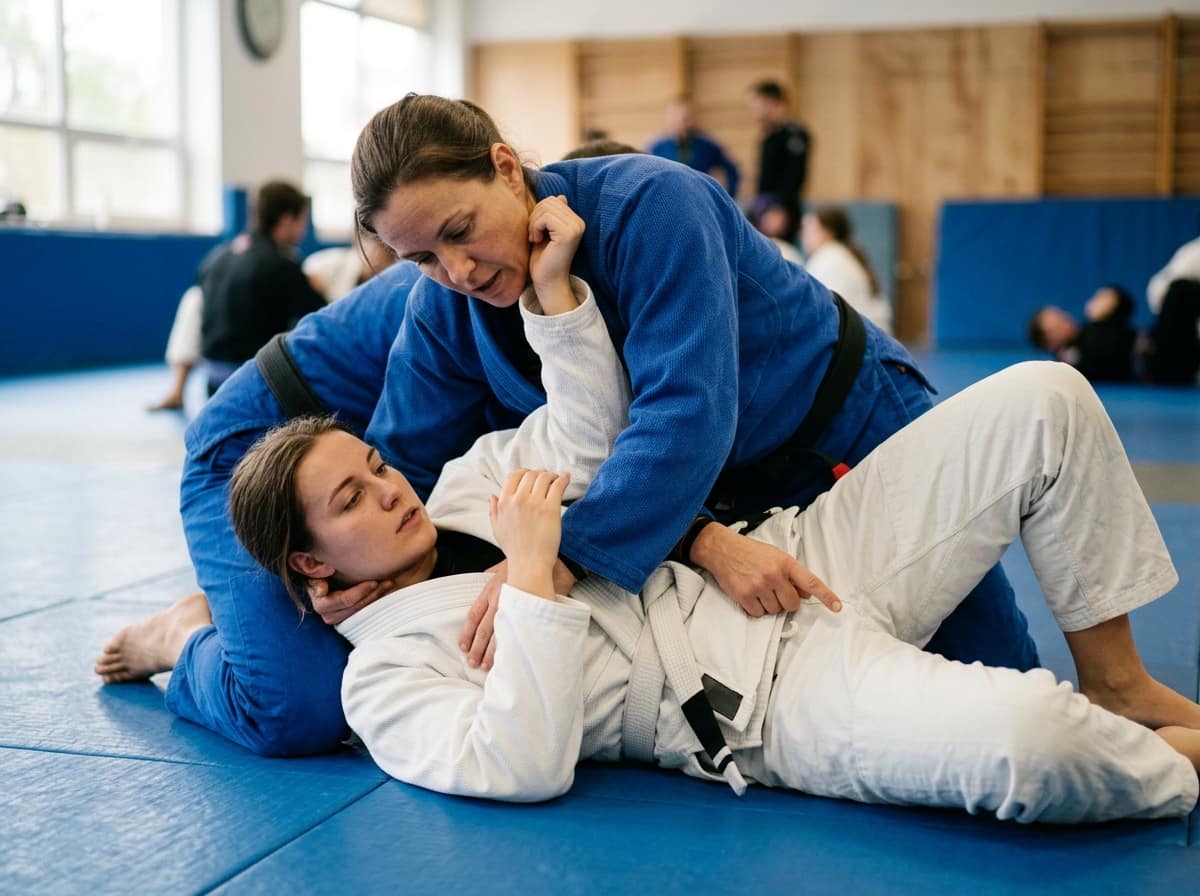
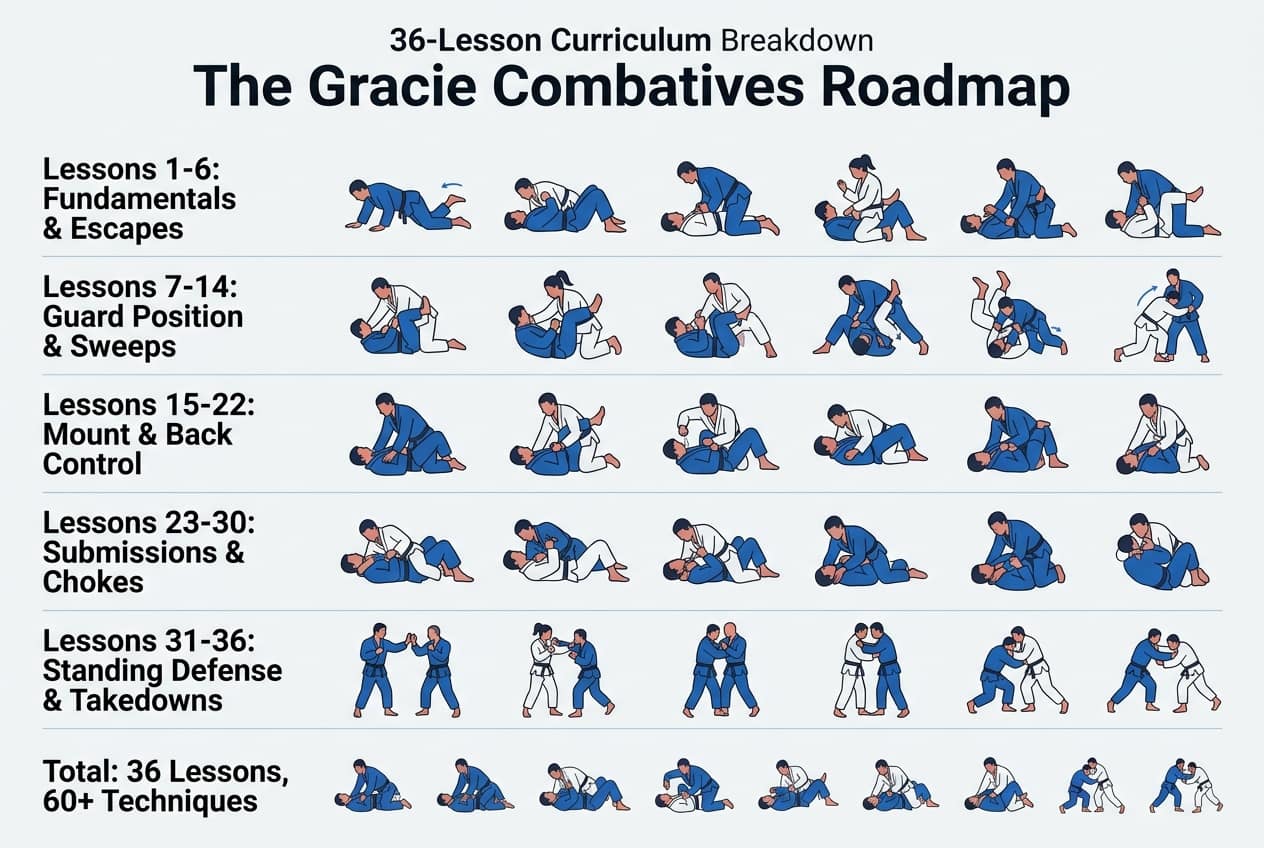
Thirty-six lessons sounds like a lot until you see how they're stacked. The whole thing is built like a staircase, not a buffet. You start on your back, fighting off disaster, and you end up standing, controlling where the fight happens. Nothing here is random. Each lesson assumes you've absorbed the one before it, which is why skipping around tends to backfire for most students.
Core Escapes and Positional Control
The opening stretch of lessons is all defense, and that's on purpose. If you can't survive bad positions, nothing else matters. This is where the Trap & Roll mount escape gets drilled relentlessly, along with the reactions you need when someone bigger has you pinned or swinging.
- The Trap & Roll escape teaches you to bridge, trap an arm, and roll a mounted opponent before they can posture up and strike.
- Headlock counters address one of the most common street and sport scenarios, showing how to escape a front headlock without gassing out.
- Punch block series drills cover how to protect your face and create space while stuck underneath someone in mount or guard.
- Guard retention concepts get introduced here too, teaching you to keep a leg or arm barrier between yourself and an attacker.
- Side control escapes round out the early curriculum, reinforcing hip movement and framing as the two skills you'll reuse constantly.
Submissions and Takedowns
Once escapes feel automatic, the curriculum shifts toward finishing a fight instead of just surviving one. You'll meet the Kimura, the Guillotine, and the Triangle Choke, three submissions that show up in nearly every grappling style worldwide, from Judo cross-training to modern MMA. For anyone curious how this all lines up with formal ranks, the bjj belt timeline is worth reading alongside these lessons, since the skills mirror that same slow-build logic. Takedown lessons close things out, covering clinch fighting, the double leg, and body fold techniques for getting an opponent safely to the ground. It's not flashy. It's just effective, which is sort of the whole point.
Gracie Combatives vs. Traditional BJJ Training
Self-Defense Focus vs. Competition Focus
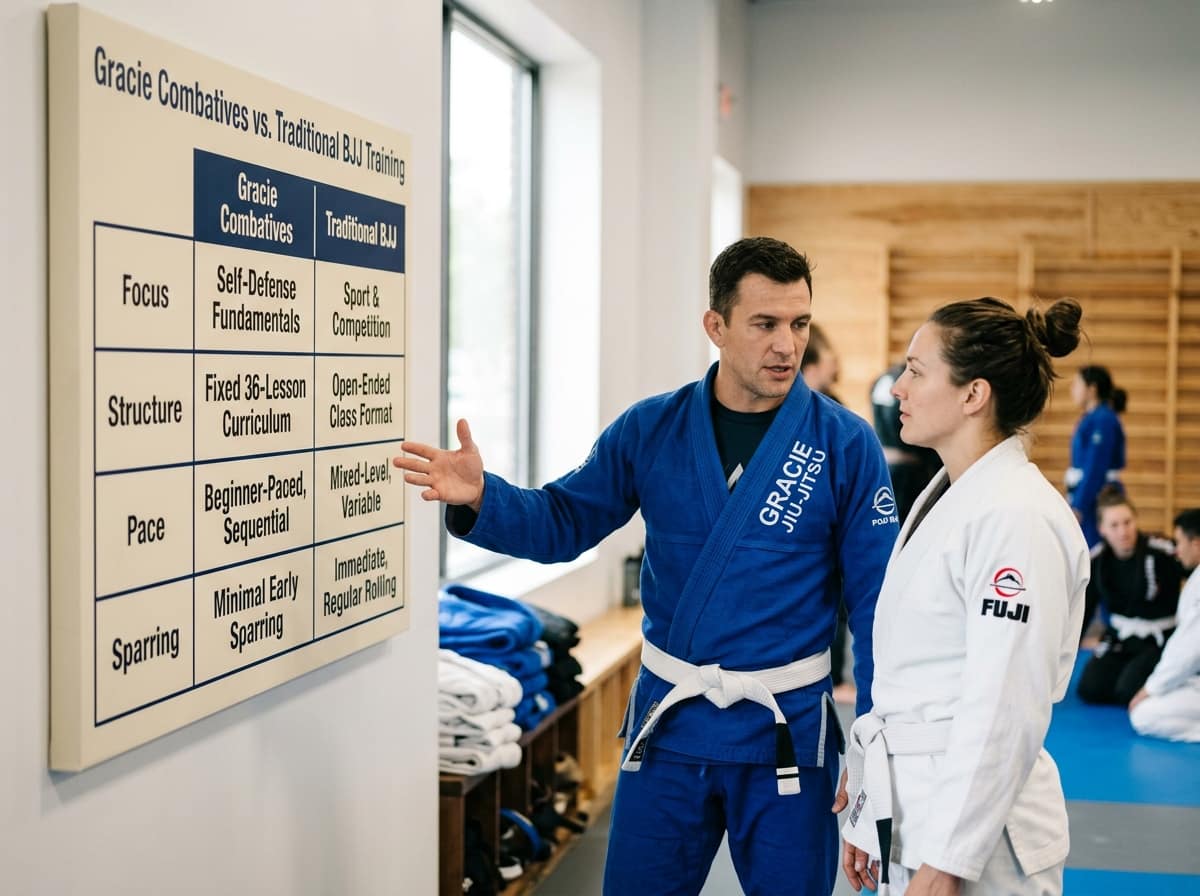
Combatives builds around efficiency, not athleticism. Every move is stripped down to the least amount of movement needed to survive a real fight, which matters if you're 40 years old and not trying to out-scramble a 22-year-old. Traditional academies, by contrast, often start students sparring within the first few classes. That's great for building instincts fast, but it can overwhelm someone with zero base. Combatives holds off on live rolling until the fundamentals are drilled into muscle memory, and it includes punch-block defense you simply won't find at most sport-focused gyms. Anyone serious about a well-rounded background should spend time on the [royce gracie academy](https://roycegracielifestyle.com/blogs/news/royce-gracie-academy) approach to see how self-defense sequencing differs from a typical competition class.
| Element | Combatives | Traditional BJJ |
|---|---|---|
| Primary goal | Self-defense against an untrained attacker | Winning against a trained opponent |
| First few classes | Drilling, no sparring | Live sparring often introduced early |
| Guard variety | Minimal, essential positions only | Wide range, including sport-specific guards |
| Strike defense | Punch-block series included | Rarely covered |
| Physical demand | Low, leverage-based | Higher, athleticism rewarded |
Learning Curve for Beginners
Here's the honest tradeoff. Combatives feels slower at first, almost boring to someone chasing quick wins. But that patience pays off, because you're not getting smashed by blue belts in week two. Traditional training throws you in sooner, which builds toughness quicker but can also scare off newcomers who quit before month three. Neither path is wrong. Both eventually cover the same belt-level knowledge. They just take different roads to get there, and plenty of practitioners end up cross-training both once they've got a foundation.
How the Belt Progression Works in Jiu-Jitsu
Where Combatives Fits Into the Belt System
Going from white to black belt is a long haul. For most adults training a few times a week, expect somewhere between 8 and 12 years. There's no shortcut, and anyone promising otherwise is selling you something. What you can control is the quality of your foundation, and that's exactly where the early curriculum earns its keep.
At many Gracie-affiliated academies, the introductory program covering fundamentals like escapes, control positions, and basic submissions is treated as a gatekeeper before students move into live sparring and competition-focused classes. The structured program known as Gracie Combatives was built around exactly this idea: master the basics under low pressure before you're thrown into the chaos of rolling against a resisting opponent. It's not about slowing you down. It's about not skipping steps that matter later.
Stripes exist to mark understanding, not trophies. A student can rack up tournament medals and still be missing pieces of technical knowledge that stripes are meant to confirm. Instructors typically award them based on demonstrated grasp of specific techniques, positional awareness, and teaching ability, not podium finishes. That distinction matters if you're evaluating your own progress or picking an academy.
Where Combatives Fits Into the Belt System
Youth belt systems run on a different track entirely. Kids typically move through belts like white, grey, yellow, orange, and green before ever reaching the adult color belt system, with stripes tied partly to age, partly to attendance, and partly to behavior on and off the mat. A seven-year-old and a fifteen-year-old on the same technical level won't necessarily wear the same belt.
This layered approach keeps younger students motivated with frequent, achievable milestones rather than waiting years for a single promotion. Many local businesses running kids' programs lean on this structure heavily, since shorter attention spans need shorter feedback loops. It also gives parents a clearer sense of progress than the slower-moving adult ranking system ever could.
Training Options: Online Academy vs. In-Person Classes
Once you know what the curriculum covers, the next question is how you actually want to learn it. The online academy route gives you self-paced video lessons, followed by a certification test once you've worked through the material. In-person academies flip that setup entirely: you get live coaching, real partner drilling, and a coach correcting your hip position in real time. There are also law enforcement and military adaptations of this same curriculum, built specifically for tactical and control-based scenarios rather than sport competition.
Pros and Cons of Self-Paced Learning
Self-paced training has real upside. You set the schedule, the cost is usually lower, and you can rewatch a confusing lesson ten times without anyone waiting on you. That last part matters more than people admit. Before signing up for either format, it's worth reading through a candid discussion of Gracie Combatives from actual students to see how the pacing worked for them. But video lessons can't fight back. There's no resistance, no unpredictable partner, and no one catching you when your form slips. It also demands discipline most people overestimate having.
In-person classes solve the resistance problem, obviously. A live partner exposes flaws a screen never will, and training alongside others builds accountability that keeps you showing up. The trade-off? Fixed schedules, higher monthly cost, and the fact that your options depend entirely on what's within driving distance.
| Factor | Online Academy | In-Person Classes |
|---|---|---|
| Pacing | Self-paced, repeatable | Fixed class schedule |
| Feedback | Self-assessed | Live coach correction |
| Resistance training | None | Partner drilling |
| Typical cost | Lower, one-time or subscription | Higher, monthly dues |
| Accessibility | Anywhere with internet | Limited by location |
Honestly, most serious students end up doing both. Learn the mechanics online, then bring the questions to the mat.
The Gracie Family's Role in Jiu-Jitsu History
Helio and Royce Gracie's Legacy
Helio Gracie was never the biggest guy in the room. That's exactly why he mattered. Too frail for the power-based Judo his brother Carlos brought back from Japan, Helio reworked the throws and holds around leverage and timing instead of brute strength. The result became Brazilian Jiu-Jitsu, a system built on the idea that a smaller, calmer fighter could beat a bigger, stronger one if he understood angles and patience better than his opponent did.
Decades later, Royce Gracie put that theory on live television. Weighing under 180 pounds, he walked into the early UFC tournaments of the 1990s and dismantled boxers, wrestlers, and karate stylists twice his size. He won three of the first four UFC events, often submitting opponents who had no idea what was happening to them until it was over. Those wins weren't luck. They were proof, delivered in real time, that Helio's adaptation actually worked against unscripted violence.
How the Family Shaped Modern MMA
The Gracie name didn't stop with Helio and Royce. Sons, nephews, and grandchildren opened academies across Brazil and later the world, each teaching a slightly different flavor of the family art. Some lean toward sport grappling, others toward self-defense fundamentals meant for someone who's never rolled before. That branching lineage is part of why schools carrying the name vary so much in feel. A program like Gracie Combatives® NYC reflects one specific curriculum passed down through that chain, distinct from a sport-focused competition gym down the street.
What ties it all together is storytelling. Spotlight-style profiles and oral histories, the kind passed from instructor to student before a class even starts, keep technique origin stories alive for people who never trained with Helio or watched Royce fight live. A sweep or a choke means more when you know why it was invented and who needed it first. That's the difference between memorizing moves and actually understanding the art.
Tips for Getting the Most Out of Your Training
Building Consistency as a Beginner
Progress in Jiu-Jitsu doesn't come from one great class. It comes from showing up, over and over, and doing the boring reps nobody films for social media. Slow, deliberate drilling beats rushing every time. If you want to see the exact lesson order this approach is built on, watching the full Gracie Combatives lesson series gives you a clear map before you ever step on the mat.
A few habits separate beginners who stick with it from those who quit after a month:
- Drill each escape slowly, focusing on the correct hip movement and hand placement, before your partner adds any real resistance.
- Prioritize breathing and base before you even think about submissions, since a calm body under pressure is what actually keeps you safe.
- Track your progress lesson-by-lesson instead of rushing ahead, noting what felt smooth and what still falls apart under pressure.
- Revisit fundamentals every few weeks rather than assuming you've "moved past" them, because basics tend to quietly rot without upkeep.
- Ask higher belts to check your form on basic movements, not just your submissions, since small errors compound fast.
Skip the base work and you'll build a house of cards. It looks fine until someone leans on it.
Gear and Lifestyle Habits That Support Training
What you wear to and from class matters more than people admit. Breathable tees and moisture-wicking layers keep warm-ups comfortable, while a durable hoodie earns its keep on cold mornings or long travel days to tournaments. None of this replaces mat time, but it removes small frictions that add up over months of consistent training.
Plenty of practitioners also like carrying their training identity beyond the gym doors. Academy logo tees, comp duffels for gear, and simple everyday layers all do that job without much thought required.
Once you've felt what Gracie Combatives can do for your confidence and skills on the mat, it's natural to want to carry that mindset into everyday life—and that's where Royce Gracie Lifestyle comes in. Their collection, from the Helio Gracie Lineage Tee to the Royce Gracie Signature Hoodie, lets you wear the family's legacy with the same free shipping and returns on every order, no matter where in the world you're training. Stop by and find a piece that fits your journey.