


You've watched a black belt tie on their belt and wondered exactly how many years, tears, and taps stand between you and that moment. It's not as simple as counting stripes. The gracie brazilian jiu jitsu belt system carries nearly a century of family tradition, strict promotion standards, and real meaning behind every color you'll earn on the mats. Here's what it actually takes to climb the ranks, straight from the art's founding family.
Understanding the Gracie Brazilian Jiu Jitsu Belt System
Why Rank Matters Beyond the Mat
The belt ranking method traces back to Helio Gracie's academy in Rio de Janeiro. Rank wasn't handed out for winning trophies there. It was a record of survival — of hours spent getting outmuscled, tapped, and slowly figuring things out. You can read more about that era in the gracie spotlight Helio Gracie feature, which digs into how the family's early teaching approach shaped everything that followed. That origin still matters today. It's why a black belt from a Gracie-lineage academy carries a certain weight.
A belt in this system reflects three things at once: technical ability, time invested, and character. That last part trips people up. Attitude on the mat counts as much as any armbar. An instructor is watching how you treat newer students, whether you show up when you're tired, and if you keep your ego out of drilling. Skip that piece and your promotion stalls, no matter how sharp your guard passing looks.
How Promotions Are Decided
Promotions in this tradition are earned through direct, ongoing evaluation by an instructor who knows you. Not through points, medals, or tournament brackets. That's a real departure from sport-focused federations, where competition results and structured testing curricula often carry more formal weight. Gracie-style academies lean on the relationship between teacher and student, built over months and years of mat time, rather than a checklist filled out on test day.
If you want a deeper breakdown of how those decisions actually get made, understanding the belt system from an academy's own perspective is genuinely useful reading before your next evaluation. Instructors are weighing consistency, defensive fundamentals, and how you perform under pressure against people your own size and skill. There's no shortcut. Later in this guide, we'll walk through the adult ranks in detail, then cover the separate junior track — which follows its own pacing and age-appropriate milestones entirely.
The Adult Belt Ranks Explained
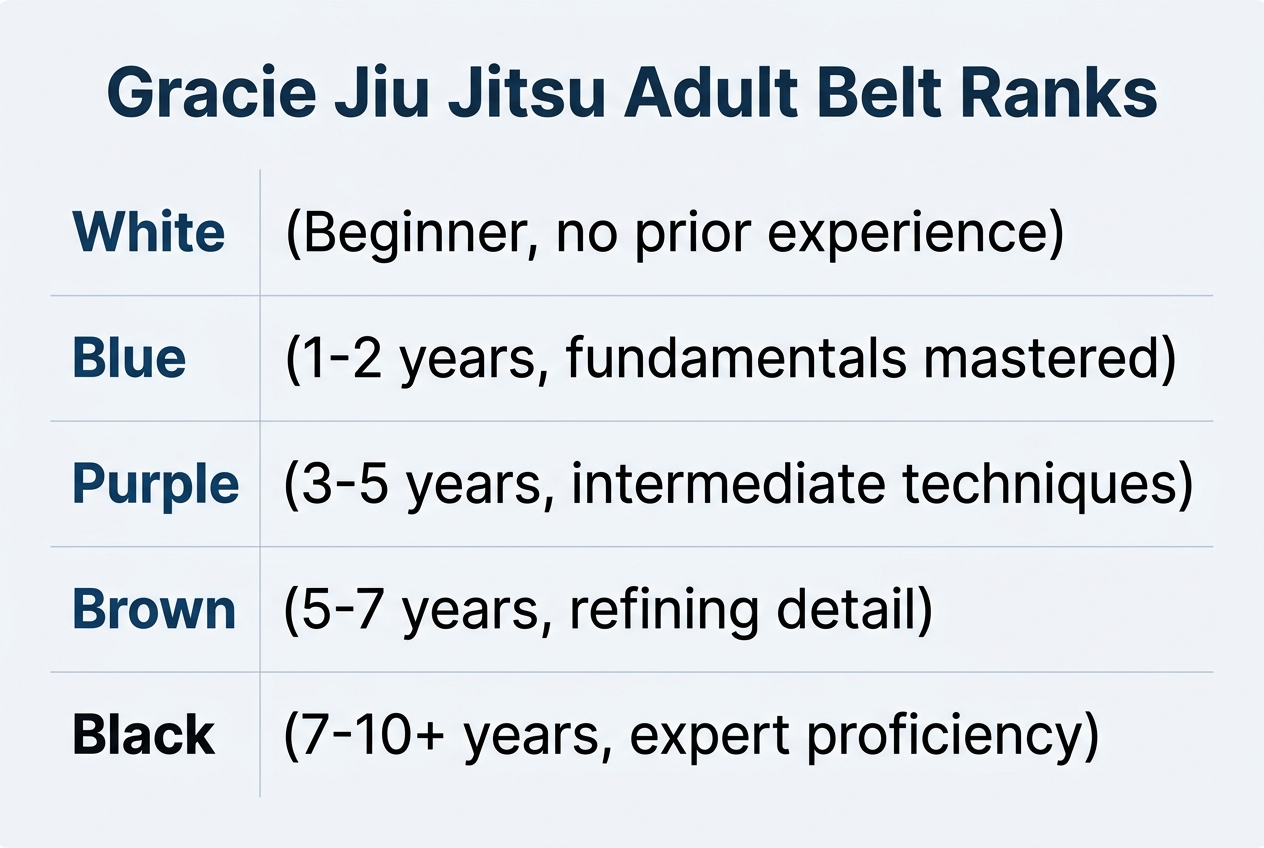
Five belts make up the adult path, and each one asks something different of you. White belt is about survival — learning to defend, escape bad positions, and stop panicking when someone's on your chest. Blue belt is where volume kicks in. You're rolling constantly, absorbing technique, and starting to trust your body under pressure. It's the longest belt for most people, and often the one where folks quit.
Purple belt marks a real shift. You start refining a personal game instead of collecting techniques, and you'll likely be asked to help teach newer students. Brown belt sharpens everything — details matter more, mistakes get punished harder by training partners, and instructor responsibility starts creeping in. Black belt isn't a finish line. It's a commitment to leadership and to lifelong learning that doesn't stop once you tie the belt on.
What Changes Mentally at Each Color
The mental shift matters as much as the technical one. White belts are often overwhelmed, just trying to not get submitted. Blue belts get a little cocky, then get humbled, then settle into steady confidence. Purple belts start thinking like problem-solvers rather than technique-collectors. Brown belts get quiet and precise. Black belts, ideally, stop worrying about winning every roll and start caring about the art itself.
Typical Time Spent Per Belt
Timelines vary by academy, training frequency, and body type. Still, there are rough industry norms worth knowing. Reviewing a general bjj belt timeline alongside the table below can help set realistic expectations rather than comparing yourself to outliers.
| Belt | Typical Time to Next Belt | Core Focus |
|---|---|---|
| White | 1–2 years | Defense, escapes, survival |
| Blue | 2–3 years | Volume rolling, technique expansion |
| Purple | 2–3 years | Personal game, early teaching |
| Brown | 1–2 years | Detail refinement, instructor prep |
| Black | Ongoing | Mastery, leadership, longevity |
Add it up and you're looking at roughly eight to twelve years for the average dedicated student, sometimes longer. Anyone promising a shortcut is selling something. For a deeper look at what the colors actually represent beyond time served, this piece on Understanding the BJJ Belt System: What Do the Colors ... breaks down the reasoning many academies use when awarding rank.
Stripes and Degrees: Tracking Progress Between Belts
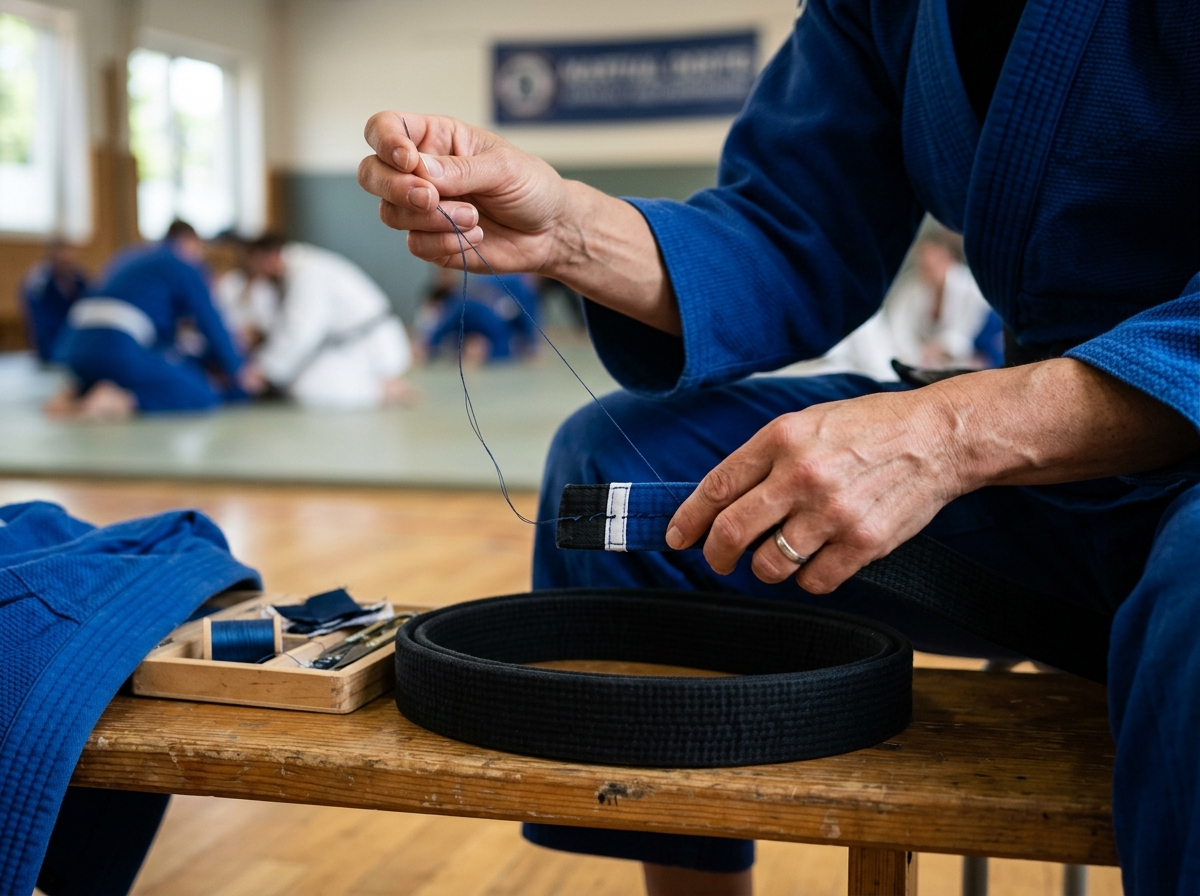
A stripe is a small marker, usually a bit of tape or embroidery near the tip of the belt. But it means a lot. It tells you where you stand between the bigger jumps in rank. Most belts can carry up to four stripes before a student is even considered for promotion, so they act as checkpoints along a much longer road. Think of them as progress reports rather than achievements in themselves. A blue belt with three stripes still has real work ahead before purple belt is on the table, and that's by design. Stripes keep motivation alive during the long stretches between color changes, which in adult belts can take years.
Instructors don't hand out stripes just for showing up, though attendance matters more than most beginners realize. They're watching how you roll, whether your defense has improved, and whether your attitude on the mat matches the effort you claim to put in. Some coaches announce stripe promotions during class; others do it quietly after training. If you want a fuller picture of how one respected academy structures these evaluations, reading about the royce gracie academy curriculum is a good place to start. Consistency matters more than talent here. Show up, stay coachable, and the stripes tend to follow.
Degrees work differently. Once you reach black belt, progress is measured in degrees, marked by a red bar on the belt, awarded roughly every three years based on continued teaching, competing, and contribution to the art. A sixth-degree black belt represents decades of dedication, not just mat time. It's a career timeline stitched into fabric. New students shopping for their first Official Gracie Jiu belt won't need to think about degrees for years, but it helps to know the system doesn't stop at black.
Junior Belt Ranks and How They Differ From Adult Ranks
Kids don't train the same way adults do, so the belt path looks different too. Most academies split junior students into age brackets, and each bracket carries its own set of belt colors that never overlap with the adult system's black belt track. This isn't a shortcut version of adult BJJ. It's a separate structure built around how young bodies and young attention spans actually develop.
Age Brackets and Belt Colors
Programs generally divide students into groups like 4-7, 8-12, and sometimes a 13-15 bridge bracket, with belt colors that mirror the rainbow progression found in many martial arts systems. A student researching options will often find a general Brazilian Jiu Jitsu Belt Guide useful for seeing how youth colors map loosely onto adult ranks without being identical to them. Common patterns include:
- White through grey, yellow, orange, and green belts for the youngest students, often with additional stripes marking small milestones along the way.
- Longer time requirements between colors than adults face, since technical depth builds slower at younger ages.
- Separate testing criteria that weigh coordination and listening skills as heavily as technique itself.
- No submission-focused sparring for the youngest brackets, with an emphasis on positional control instead.
- Instructor discretion playing a bigger role than fixed time-on-mat requirements.
Transitioning From Junior to Adult Rank
Discipline and respect matter more than submissions here. Falls, rolls, and following instructions on the first try count for a lot. Most academies convert a junior rank into an equivalent adult color once a student turns 16, though the exact color earned depends on skill demonstrated, not just age reached. A junior green belt doesn't automatically become an adult blue belt. Some students get bumped up, others repeat testing.
For parents choosing a program, ask how the school handles that transition, how often kids test, and whether instructors run separate youth-only classes. That's a bigger deal than trophy walls or flashy belt colors.
What Belt Testing Actually Looks Like
Walk into a real promotion and you won't find a stage or a microphone. Most tests happen quietly, often after regular class, with an instructor calling students up one at a time or in small groups. You'll demonstrate a set curriculum of techniques on request, then roll live so the instructor can see whether the moves actually hold up against resistance. That live component matters more than the drilling. Technique under pressure is the real test.
The exact requirements shift by academy and by belt, but the general shape stays consistent. Here's a rough breakdown of what instructors are checking for at different stages, and why some students get held back longer than others.
| Test Stage | Typical Structure | What's Evaluated | Common Delay Reason |
|---|---|---|---|
| Stripe test | Short, informal, often mid-class | 2-3 techniques, basic timing | Inconsistent attendance |
| White to blue | One-on-one with instructor, 20-30 min | Fundamental positions, escapes, submissions | Weak defensive instincts |
| Blue to purple | Group setting, live rolling included | Guard passing, transitions, composure | Relying on strength, not technique |
| Purple to brown | Extended evaluation, sometimes multi-day | Chain attacks, teaching ability | Gaps in less-favored positions |
| Brown to black | Panel or senior instructor review | Mastery, mat leadership, mindset | Time-in-grade minimums not met |
Beginner Belt Test Expectations
At white and early blue belt, instructors are watching for control more than flash. Can you hold side control without panicking? Do you tap before injury rather than after? Because expectations vary so widely between schools, learning what a formal evaluation involves helps set realistic expectations before you're ever called up. Mental composure gets weighed just as heavily as technique here — a student who stays calm under a bad position often ranks ahead of one who muscles through it.
Advanced Belt Test Expectations
Purple belt and beyond, testing stops being about individual moves and starts being about depth. Instructors expect fluid chains: a failed pass leads straight into a sweep attempt, then a submission threat, without hesitation. Teaching skill enters the picture too — brown belts are often asked to instruct a class segment. Delays at this level rarely come from bad technique. They come from unfinished time requirements, thin attendance records, or an instructor simply wanting to see more consistency under pressure first.
Tips for Progressing Faster Through the Ranks
Belts don't come from wishing. They come from time on the mat, and how you spend that time matters more than how much of it you log. Two white belts can train the same number of years and end up worlds apart in skill, simply because one trained with intent and the other just showed up. If you're serious about climbing through the Gracie jiu ranking structure, treat every class like it's building toward something, not just burning an hour.
Progress isn't one habit. It's a handful of small disciplines stacked together, week after week. Here's what actually moves the needle for practitioners who advance faster than their peers:
- Show up consistently, three to four times a week, rather than cramming five sessions into one week and disappearing the next.
- Balance your training between slow, focused drilling, hard live rolling, and quiet study of instructional videos so technique actually sticks under pressure.
- Ask higher belts and coaches for direct feedback after rolls, since a thirty-second correction can save you months of repeating the same mistake.
- Protect your body with proper warmups, stretching, and basic hygiene habits, because a skin infection or blown-out knee will cost you more mat time than any plateau.
- Sleep and eat like training matters outside the gym too, not just during the sixty minutes you're on the mat.
- Expect long stretches where nothing seems to improve, then push through them anyway, because that's usually right before things click.
That last point deserves its own word: plateaus. Every belt has one, usually right before promotion, and it feels endless while you're in it. Most people quit right there. Don't be most people. The ones who stick around develop the kind of quiet, stubborn mental resilience that ends up mattering more than any single technique they ever learn.
Wearing Your Rank With Pride Off the Mat
Your belt tells a story, but you can't wear it to the grocery store. That's why so many practitioners lean on lifestyle apparel to carry that same identity into everyday life. A worn hoodie with academy branding, a tee that nods to your coach's lineage, a hat that quietly signals "I train" without shouting it — these small choices matter more than people expect. They're a way of saying you put in the mat time, even when you're nowhere near the mat. Rank isn't just a belt color; it's a personal history, and clothing is one of the simplest ways to carry that history around.
The Gracie name carries weight precisely because rank has always meant something specific within that lineage. Every academy sets its own bar for what a stripe or a belt promotion actually requires, and standards can vary more than newer students realize. Anyone curious about how rigorous this gets should look at how one respected Texas school documents its own criteria, and understanding the Renzo Gracie DFW adult belt standards makes clear just how much thought goes into a single promotion. That kind of transparency is worth remembering next time someone dismisses belt rank as arbitrary.
For families, the goal is a little different. Kids want gear that feels earned, not costume-like, while parents want something durable enough to survive actual play. Adults, meanwhile, tend to favor understated pieces — a plain tee, a solid hoodie, minimal logos — over anything flashy. Round it out with the basics: a good gym bag, a water bottle, maybe a beanie for cold mornings before class. Small stuff, sure. But it adds up to a wardrobe that actually reflects the grind.
Wherever you find yourself on the belt journey, wearing that progress off the mat is part of the fun—and Royce Gracie Lifestyle makes it easy to celebrate it with pieces like the Royce Gracie Rank Tee and Hoodie, inspired directly by the legacy of the man who proved Jiu-Jitsu to the world at UFC 1. Every order ships with free standard shipping and returns, so trying out a new tee or hoodie from the collection is completely risk-free. Explore the full lineup at Royce Gracie Lifestyle today and bring a piece of authentic Gracie heritage into your everyday wardrobe.